The Holiday Perdition
What has become known as the Week of Perdition, "Christmastide" or the "Twelve Days of Christmas" (technically running from December 25 through January 5), has a name that sounds serene, but historically, it's a mix of feasting, downtime, and social inversion rather than nonstop cheer.
Lya Brk Ujv
12/25/20254 min read

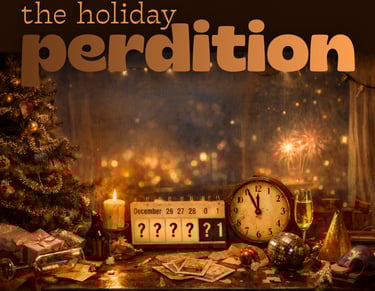
There’s a strange purgatory that exists between Christmas and New Year’s, a long-yet-short week where time loses its shape and everyone pretends this is normal. The decorations are still up but emotionally expired. The music keeps playing even though no one is listening anymore. Receipts sit folded in pockets like tiny accusations, and now even returning the wrong thing comes with a fee, as if the universe itself is charging interest on regret. It’s a retail nightmare with a festive hangover, and everyone is wandering through it pretending they’re not disoriented, lonely, or quietly annoyed at everything.
This is the week where people suddenly become philosophers. Everyone starts issuing unsolicited “new year, new me” speeches as if they’ve cracked the code to existence overnight. You can feel the fake strain in it. The forced optimism. The desperate need to believe that January 1st is a personality reset button instead of just another morning with the same problems. Meanwhile, they excuse every slight, every emotional letdown, every ongoing disappointment with the same tired mantras.
This is the time people lie to themselves most convincingly. Not maliciously, just out of exhaustion or out of habit. Out of the need to survive another year without admitting how much of it felt hollow, repetitive, or misaligned and even unrequited. Reflection creeps in whether invited or not. You start replaying conversations you shouldn’t. You start questioning choices you swore you were at peace with. You wonder how you got here, what you’re actually building, and whether any of it feels intentional anymore.
It’s awkward because there’s no script for this part. Christmas tells you how to feel. New Year’s Eve tells you how to act. But this week in between offers no instructions. It’s just you, the mess you didn’t clean up yet, the expectations you didn’t meet, and the creeping realization that time doesn’t pause just because the calendar is changing fonts.
And somewhere in the middle of all that, you catch yourself asking the most honest question you’ve asked all year. What am I even doing? Not dramatically, not tragically, just plainly. What am I actually doing with my time, my energy? And honestly, if you feel irritated, reflective, or quietly over it all, congratulations. You’re not "fucked up" person; you're paying attention>>so you're painfully aware>>>and now you're going through the motions until it's really over. And when the dust settles and you are able to catch your breath. . . BOOM: Valentines Day pops up! 😆 You gotta love life, ya know?!
Most people stumble out of a Black Friday shopping daze straight into the glitter of Christmas, and before they even catch their breath, it’s New Year’s Eve again. What they think of as “New Year’s traditions” — kissing at midnight, eating 12 grapes, wearing red underwear for luck, or waiting for that ball to drop — are mostly folk superstitions repackaged for Instagram and retail calendars. These habits have real roots, but they’ve been diluted, marketed, and turned into something shallow and commercial.
Take the romantic midnight kiss. It isn’t just polite etiquette; it comes from old European beliefs that whoever you’re with when the clock strikes twelve will shape the course of your relationships in the year ahead. People still swear by it, and surveys show many Americans consider it a meaningful luck-bringer rather than just a moment for a selfie. Then there’s the Spanish tradition of eating 12 grapes at midnight — one grape for each month of the year, each tied to a wish or hope. The idea is not just to see how many you can shove in your mouth at once, but to set intention for the next 365 days.
Folk customs like putting cash in your wallet for prosperity or slipping on red underwear to attract love are similar. They’re symbolic, playful, and culturally contagious. They make for great party moments, but they don’t necessarily reflect how spiritual practitioners actually engage with the turning of the year.
Contrast that with how real occultists, witches, and pagans approach New Year’s Eve. To them, December 31st isn’t a backdrop for commercials and sales — it’s a liminal moment, a threshold between what has passed and what is yet to come. Where most households might deal with leftover lights and vacuum before midnight, practitioners often engage in cleansing rituals and intention setting. Smoke cleansing with herbs, burning bay leaves with written wishes, or taking a ritual bath aren’t household chores — they’re ways of releasing stagnation and making room for renewal.
Divination on New Year’s Eve isn’t just party fun. Tarot readings, rune castings, and pendulum work are tools for reflection and insight, helping practitioners interpret energetic patterns and prepare for what lies ahead. These aren’t casual guesses; they are thoughtful spiritual practices that treat the shift from one year to the next as something meaningful.
Real occult traditions see feasting differently as well. Foods chosen for color and shape — round fruits for completeness, greens for prosperity, lentils or coins for luck — become symbolic anchors rather than just snacks on a buffet table. What looks like holiday indulgence to the uninitiated often has intention woven into every bite.
Most pagans and witches aren’t against celebration. They simply reframe it. Instead of rushed shopping and impulse buying, they build rituals and moments that honor cycles of nature and personal transformation. The modern retail spectacle of Christmas and New Year’s can feel like noise to them — a distraction from intentional action. Instead of following a checklist of viral customs, they clear their spaces, set deliberate intentions, and gather in community with purpose.
So next time someone posts a viral video about red underwear or the perfect midnight kiss, you can explain with confidence that those are fun superstitions, not deeply rooted spiritual practices. Real tradition treats the New Year as an energetic reset — a sacred pause rather than a commercial countdown. Understanding that difference makes your celebrations richer, more intentional, and a lot more interesting than another run to the mall.

G8WAY intellectual property found herein is branded as such and most graphic interchange formats along with all links lead to external businesses not owned or operated by G8WAY. If you own any image included here and wish to request its removal or proper attribution, please contact admin@g8way.online or coolcat@g8wayonline and you'll get a response as promptly as possible. Please note: a page’s presence in G8WAY does not imply it is complete. Each entry is a living document that may be subjected to editorial corrections and/or additions. G8WAY may earn a commission when users make a purchase through links posted throughout this site. Information on WWW.G8WAY.ONLINE is opinionative and for entertainment purposes only and should not be considered professional advice. Thank You for Visiting! G8WAY.ONLINE ©2026 All rights reserved.