Reality Check: The Science Behind the Symbolism
Before anyone gets too mystical with modern ashes, here’s the hard truth:
Cremation destroys DNA.
Temperatures between 1,400°F and 1,800°F obliterate all genetic material. So, what’s left isn’t biological — it’s ground-up bone fragments aka calcium phosphates. Symbolic, yes. Spiritual? Not at all; it's all reasonably explainable. And although crematories follow strict protocols to avoid mixing remains — Heritage Oaks Memorial Chapel confirms that each person is cremated individually — there’s still reality to face: tiny dust particles of other corpses linger.
Those micro-particles from previous cremations can remain in the chamber, meaning that modern ashes are never 100% “pure.” So if you’re planning to use cremains in spellwork or divination — know that their potency is only symbolic, not literal. Industrial cremation has diluted what ancient pyres once preserved and handled differently..
Old-world fire was ritual; today’s fire is process.
Back then, ashes still carried the elemental trace of earth, air, and wood — the very fuel of the soul’s send-off. Now? It’s steel, gas, and machinery. The spiritual frequency has all but vanished from the bones. Most likely wandering about the airwaves onto the next 'state of being'.
My House Is a Mausoleum (and I’m Fine With It)
A while back, I lost family — fast. Within two months, gone. Their ashes rest in a curio in my home. Later, my husband’s mother moved in — and she brought her late husband’s urn. So now my home houses three energies. Honestly? It’s fine. It wasn’t done as ritual — just a respectful tribute. I refuse to bury them. They’re family, and they stay with me. Even if they are dead and gone. But if there is any energy attached to those ashes, I get the sense they’re giving him hell and that brings me peace.
The Orphan’s Way
Maybe one day I’ll scatter them somewhere meaningful — somewhere wind and water can carry what’s left. But for now, I keep them here. Because that’s what adult orphans do. We keep what’s left of home close to the chest. We shoot the breeze with ghosts. We laugh, we heal, we remember. It’s not macabre. It’s only human to want familiar companionship. People cope differently. Some take longer than others - especially if there's nothing to fill the void, aside from the obligatory dedication to the deceased loved one's memory.
Final Thought
Keeping ashes is a personal continuation of devotion. It’s how some of us hold space for the past — not out of fear, but out of love. The body burns. The spirit doesn’t. And sometimes, the ashes left behind are less about death — and more about what refuses to die.
Ashes to Essence: Keeping the Dead Close (and Why It’s Not That Weird)
Funeral pyres have existed since the dawn of civilization — think ancient Hinduism and Mesopotamia, long before the hedonistic Pagan days of yore. Death rituals have always been mirrors of belief: how we handle the dead says a lot about how we understand the living.
According to Patheos, cremation predates most modern religions. It wasn’t dark or taboo — it was sacred, cleansing, and symbolic of the soul’s release. Somewhere along the way, superstition took over. Now, the average person hears “ashes” and instantly thinks: creepy.
And yet, for those walking the Left-Hand Path, or anyone with deep spiritual sensitivity, keeping cremains isn’t strange at all. It’s a continuation — a way to stay connected to the energy, the essence, the ancestry that built us.
So yeah — to the regular, smegular crowd, it’s “weird.”
But to occultists, witches, and spiritualists? It’s one of the oldest acts of reverence there is.
Cremation Makes Sense
Let’s be honest — cremation makes sense — the funeral industry doesn’t. Do you know how expensive it is to die in America? Funeral and burial costs have gone from meaningful and respectful to a burdensome financial dent.”
Funeral homes, casket dealers, cemetery management — all of them see grief and smell money. They’ll size you up from the moment you walk in: how you speak, what you drive, what card you pull out. If it’s a platinum card, brace yourself. If it’s a Walmart Visa, they already know how to “adjust” your quote.
They are professionally trained to look sorrowful — not sympathetic. They’re paid to appear comforting. Let’s call it what it is: a billion-dollar grief industry that preys on your pain. You’re raw, emotional, and desperate to do “the right thing.” They see it coming. And they take advantage. So yes — cremation is the saner, simpler route. Less pageantry, more practicality.
Ancient Pyres: Fire, Earth, and True Release
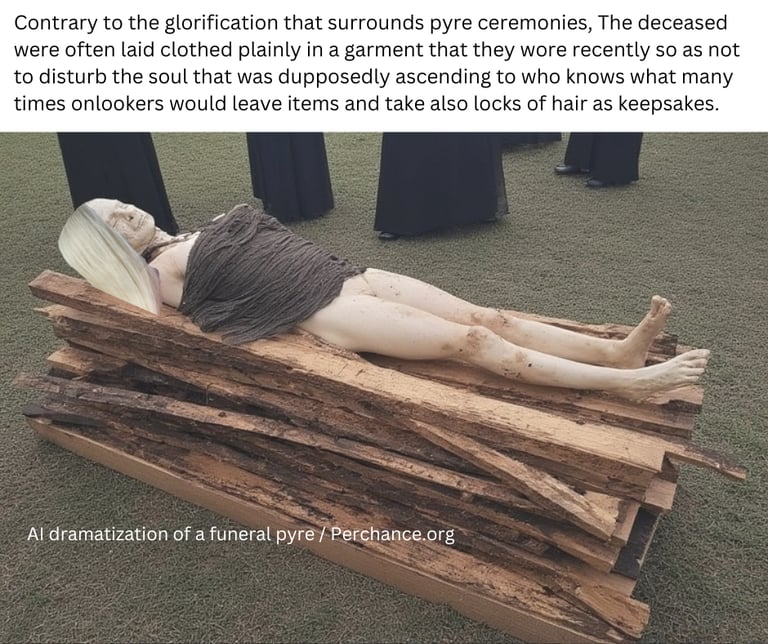
Before industrial crematories and their stainless-steel furnaces, there were funeral pyres — open-air ceremonies that fused body, earth, and fire in raw ritual. A traditional pyre wasn’t mechanical; it was personal. Built by hand. Lit with intention.
Here’s what went into it:
Wood:
The base material — usually from local trees like pine, birch, or oak. Pine was often chosen for its resin and easy flammability. Logs, branches, and cones all had a place.
Kindling & Brushwood:
Smaller twigs and brush were packed in to start and sustain the fire.
Offerings & Belongings:
Weapons, jewelry, heirlooms, or meaningful objects were placed beside the body — items thought to accompany the deceased into the next realm.
Special Additions:
Different cultures burned herbs, resins, and fragrant plants. Let’s be real, though — while the mystics might claim this was for “anointing,” it was also 100% practical. Burning flesh smells awful, and aromatic smoke made the ritual more bearable.
The Construction & Ceremony:
A sturdy base of logs formed the foundation. Kindling was stacked teepee-style to ensure air circulation and steady combustion.
The body was laid atop this structure, surrounded by offerings.
Then came the ignition — usually by a family elder, priest, or designated person — during a somber, sacred ceremony.
Compare that to now:
Good luck even getting to watch a cremation through a window. In the U.S., few institutions allow family to witness the process, and even fewer let them be present when ashes are removed from the furnace.
The distance between the living and the ritual has become industrialized — sanitized — hollowed out.
Why Witches Keep Ashes
Let’s set the record straight: not every witch keeps ashes for “magic.” Many do it for memory — for ancestor veneration and continuity. But, when it is magical, there’s purpose and discipline behind it.
Here’s how and why:
1. Ancestor Veneration
Across paganism and modern witchcraft traditions, honoring one’s bloodline is sacred work.
Ashes often rest on an ancestor altar — maybe a curio shelf, a shadow box, or a small corner of the home. Offerings like flowers, wine, or favorite foods keep the bond alive. It’s a two-way street: respect given, blessings returned.
2. Maintaining a Connection
Cremains are tangible energy. To the living, they hold essence — that emotional fingerprint of the person once alive. For some, especially adult orphans or last of their bloodline, this becomes a spiritual tether. Having them near eases the ache of loss.
3. Magical and Ritual Use
No, we’re not talking about smearing ashes across your face like a warlock in a 90s B-movie. There are specific ceremonial applications tied to lineage, divination, and protection work:
Divination:
A pinch of ashes can be used as a focal point in tarot, scrying, or bone readings to invite ancestral insight.Marking:
Some blend ashes with water to draw sigils, bindrunes, or chakra points during ritual — though this practice has obvious modern hygiene disclaimers.Protection Work:
Ashes can be sealed into amulets or spell jars, invoking family protection or ancestral guidance.Art & Memorials:
Small portions mixed into resin, glass, or even tattoo ink (see YouAreForever.com) — a symbolic fusion of life, love, and permanence.Rebirth Rituals:
Mixing ashes into soil to plant a tree or flower — a poetic reminder that death is just compost for new beginnings. (Trupoint Memorials offers keepsakes for this.)