From Cohoba to Tzompantli: The Spiritual, the Sacred, and the Brutal Truths of Ancient Rituals Across Cultures
A dive into the real spiritual practices of the Taíno, Aztecs, and global Indigenous communities— far more complex than the simplified, gentle “shamen” narrative often told. From Mesoamerica to Mesopotamia, there was an active savagery often omitted from many historians' narratives. SHARE THIS WITH PERSONS FIXATED ON REPARATIONS
INDIGENOUSCULTURAL MISCONCEPTIONMESOAMERICA
I. Burke
5/1/20265 min read
Spirituality Has Always Been Wild!
Before anyone clutches their pearls or starts side-eyeing ancient Caribbean practices like they were “demonic,” let’s keep it a buck: Spirituality has ALWAYS been prevalent, for the most part. And natives of the Caribbean were absolutely no exception. Customarily, Mesoamerica's nature-anchored inhabitants weren't as cosmically tuned in as Sumer, but were just as ruthless. Warfare, rape campaigns, and slavery were recorded happenings within Indigenous villages and empires alike. And while there were many tribes that partook in these acts with sacrificial rituals added, there were also a multitude that favored Mother Earth over Sun worship.
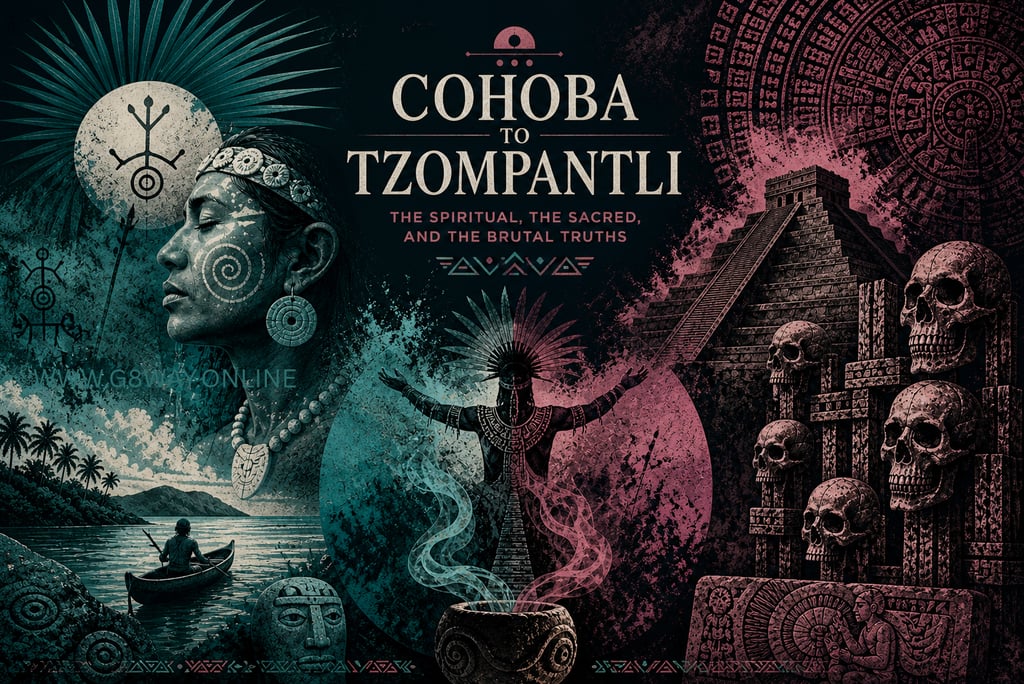
Take the Taíno people—the original inhabitants of Borikén (Puerto Rico), Hispaniola, Cuba, Jamaica, i.e., Mesoamerica—were knee-deep in a spiritual ecosystem that most modern people couldn't handle. For the Taíno, spirituality wasn’t a hobby. Like the once-a-week church trips most folks pride themselves in attending. It was the air. The land. The ancestors. The animals. The storms. The spirits. And these Taíno shamans—known as Behique—were not just “warlocks” or “medicine men.” These Behique were thee OG healer-mystics!
They were doctors, counselors. Astral travelers, botanists, visionaries and interpreters of the unseen. They held mastery over medicinal plants, healing rituals, and the delicate line between life and spirit. People trusted them with their own bodies.
A peek into the Cohoba
Central to their practice was the Cohoba ceremony, where the Behique inhaled a hallucinogenic snuff to enter trance states. Not for party vibes. But to commune with spirits, diagnose illnesses, foresee outcomes, and guide the community.
Zemis: Spirits Carved Into Reality
The Taíno honored Zemi, their deities and spirit forces, through intricately carved icons made of stone or wood. These weren’t idols—they were basically vessels for the divine, used to invoke natural powers of rain, fertility, protection, and cosmic balance. A little about ancestor veneration as I understand it. . . To the Taíno, ancestors didn’t “rest in peace.” They became supernatural guardians, advisors, and protectors. Death was not an ending—just a transformation.
Animism: The Universe Is Alive and the Taíno saw consciousness everywhere:
In trees, birds, storms, in the mountains. Everything held spirit. And honestly? That level of respect is something modern society could learn from. And before anyone judges: This was NOT unique to Puerto Rican lineage. Let’s stop acting like Taíno spirituality was some kind of isolated Caribbean phenomenon. The ENTIRE ancient world was immersed in spiritual practices that, depending on where you stood, ranged from beautiful to terrifying. And some of them? Let’s just say they made the Cohoba ceremony look like a meditation class.
The Aztecs: Brutality, Faith, and the High Price of Cosmic Order
If you want to talk about the extremes of ancient spirituality, welcome to the Aztec world—where religion, politics, and survival collided in the most intense ways imaginable.
Human Sacrifice: Hundreds Per Year
The Aztecs believed the gods needed nourishment—literal life force—to keep the sun rising and the world intact. So sacrifices were not done out of cruelty but cosmic duty and hundreds, if not thousands of people, mostly war captives, were sacrificed annually by holy men removing still-beating hearts atop towering pyramids dedicated to gods like Huitzilopochtli.
It was graphic. And it was deeply embedded in their worldview.
Tzompantli: The Skull Racks
If you walked through Tenochtitlan, you might encounter a tzompantli—massive skull racks displaying the heads of the sacrificed. Men. Women. Children. It's a visual reminder of the cost of balance within that empire— people were paraded up atop of a specially made sacrificiial podium to be (brutally, not humanely) killed and that was daily life. No martyrdom.
Average citizens were expected to bleed for the divine. Tongues, ears, limbs pierced with cactus spines to offer drops of life to their deities. Detained persons from opposing tribes were usually the go-to.
Witchcraft Punishments Worldwide: It Wasn’t Soft Anywhere
People love to act like Indigenous “witchcraft” was the peak of barbarism, but let’s be real: Fear of spiritual practitioners has always been on a global scale..
North American Tribes
In Cherokee, Chickasaw, and various other communities, individuals suspected of malevolent witchcraft faced severe punishments. Even death.
Take India’s Santhal Tribe as a Prime Example
Some of the most extreme anti-witchcraft punishments on record come from the Santhals forcing accused witches to ingest human excreta and blood before burning them alive. Spirituality can heal—but historically, it could also condemn.
So… What’s the Point of this essay?
Many are primitives descended from a lineage of savages most of whom knew nothing else but servitude or barbery. There was no in- between. What end of that scale do you think you and your ancestors were on? Moreover, any modern ideal of "what-if's" can and should be retired as our entire way of life could look like North Sentinel Island. Because as atrocious as it was, colonialization was the best thing to happen to our people.
The Real Takeaway: Shamanism and primitive ancestral rituals were as turbulent as they come, backed by eye-witness accounts by plenty of Spanish conquistadors. They recorded numerous firsthand accounts of Mesoamerican sacrificial practices, particularly during the 1519–1521 conquest of the Aztec Empire. One can state that these descriptions—while vivid—must be approached with caution, because colonial agendas shaped the reasoning, thus often exaggerating events to justify conquest by portraying Indigenous societies as barbaric.
This is in spite of the same conquistadors expressing profound awe and admiration for the landscapes, infrastructure, and urban planning they encountered in the Americas. They often compared the Aztec lands favorably to the greatest cities in Europe.
Yet the aforementioned facts do not end with dismissal. Archaeological evidence uncovered in Templo Mayor and elsewhere has confirmed that such rituals did take place, grounding parts of these accounts in material reality. They most certainly happened upon a place across the sea, cloaked in glistening minerals and rich foliage. The Mesoamerican empire seemed to beckon them, until they entered deeper into these grounds.
Several members of Hernán Cortés’ expedition left detailed testimonies. Bernal Díaz del Castillo, in The True History of the Conquest of New Spain, described priests using obsidian blades to remove the hearts of victims atop temple structures. Andrés de Tapia documented the presence of tzompantli—racks and towers constructed from human skulls—near the ceremonial center. During the Siege of Tenochtitlán, Spanish forces also reported witnessing the public sacrifice of captured soldiers.
Modern historians interpret these accounts through a dual lens. On one hand, excavations have uncovered skulls, offerings, and structural remains that align with these descriptions. On the other, numerical claims—sometimes reaching into the tens of thousands—are widely regarded as exaggerations, shaped by propaganda designed to legitimize Spanish domination.
Yet, at some point, one is left to wonder: Thousands? AND they all corroborate?
The Real Takeaway: Mesoamerican rituals weren’t savage to a peoples who did not consider themselves as such. They were expressing human connection to the unseen—expressions shared across continents, separated by oceans, yet eerily similar in essence. But, anyway, the Sun was usually their ruler, for that is where they placed their worship.
In closing, whether inhaling Cohoba to speak with Zemi… Or offering blood to keep the sun rising… History has shown, humans have a track record of claim and conquer and that cycle won't cease, no matter what Gods are involved. You ask anyone from the carribean: how do you honor Zemi? You. Will. Get a blank stare. And although these ancestral homelands were stolen, the actual traditions shouldn't have dissolved so easily; you all willfully let it go.
G8WAY intellectual property found herein is branded as such and most graphic interchange formats along with all links lead to external businesses not owned or operated by G8WAY. If you own any image included here and wish to request its removal or proper attribution, please contact admin@g8way.online and G8WAY will respond as promptly as possible. Please note: a page’s presence in G8WAY does not imply it is complete. Each entry is a living document that may be subjected to editorial corrections and/or additions. G8WAY may earn a commission when users make a purchase through links posted throughout this site. Information on WWW.G8WAY.ONLINE is opinionative and for entertainment purposes only and should not be considered professional advice. Thank You for Visiting! G8WAY.ONLINE ©2026 All rights reserved.